
Every credible opportunity competes first for time, questions, mentoring, verification and access before it competes for capital. That makes opportunity selection an allocation problem before it is a prediction problem.
The paradox behind the headline
African startup funding fell 6% year on year to $1.4 billion in the first half of 2026, while fewer early-stage companies secured investment, according to data from Africa: The Big Deal reported by Semafor. A small number of large transactions carried much of the total. More money did not mean more ventures were receiving meaningful support.
That distinction matters because it changes the real problem facing investors, accelerators, corporate partners and ecosystem programmes. The problem is not simply a shortage of promising founders. It is the disciplined allocation of scarce attention among many incomplete, uneven and often highly polished signals.
Before capital is invested, someone must decide which opportunity deserves time, questions, mentoring, verification, introductions and institutional capacity. Attention is therefore the first investment.
Selection comes before prediction
| Opportunity selection is an allocation problem before it is a prediction problem. |
The early-stage world often behaves as though every application process should identify the future winner. That is an unrealistic burden. Venture outcomes are uncertain, evidence is incomplete and selection criteria differ across mandates. An accelerator, an angel investor, a development programme and a corporate partner are not looking for the same thing, even when they are reviewing the same company.
The first responsible decision is more modest: does this signal justify the next unit of attention, what evidence would reduce uncertainty and where should the opportunity go next?
A signal is an observation that may justify a question. An opportunity is a possible pathway to value that fits a defined actor or mandate. Eligibility asks whether the applicant may enter a process. Readiness asks whether the venture can use this particular opportunity productively now. Selection decides who receives scarce capacity. Assessment examines the venture and founder. Due diligence corroborates claims before capital or formal authority is committed.
| Collapsing those decisions into one score creates false confidence. A signal earns a question, not a cheque. |
The Opportunity Filter
The Opportunity Filter is designed as a routing discipline rather than a success-prediction model:
| Mandate → Relevance → Evidence → Readiness → Additionality → Risk → Next Evidence → Route |
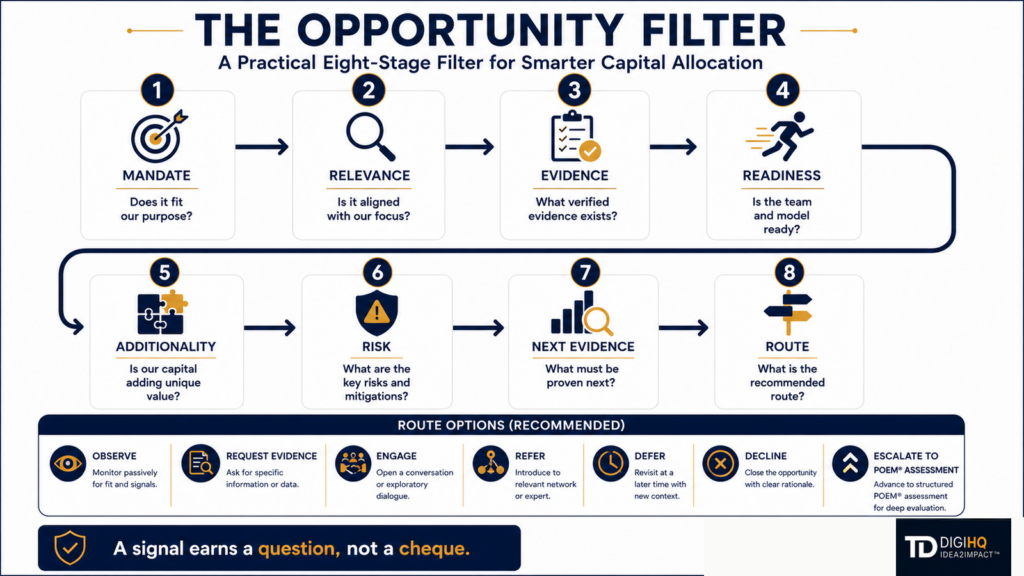
Mandate comes first. Does the opportunity fit the provider’s purpose, sector, geography, stage, ticket, capability and time horizon? A compelling venture outside the mandate is still outside the mandate. This is a hard gate, not a score to be averaged away.
Relevance asks whether the underlying problem matters to the intended customer, beneficiary or market, and whether the timing is credible. Fashionable sectors should not receive attention merely because they are fashionable.
Evidence separates what has been demonstrated from what has been asserted. A polished presentation is not the same as a verified customer, a functioning product, a repeatable process or independently corroborated demand. Missing information should be labelled as uncertainty, not automatically treated as poor quality.
Readiness is specific to the opportunity. A venture may be ready for an accelerator but not for institutional equity. It may be ready for customer pilots but not for debt. Recent financing in Africa’s off-grid solar sector illustrates the point: sophisticated structures became possible only after years of operational experience, repayment histories, standardised financing structures and stronger performance data, as reported by the Associated Press.
Additionality asks whether the provider can add something material. Capital, mentoring, market access, technical capability, credibility and networks all have value. A good opportunity for one provider may be a poor fit for another that cannot contribute beyond publicity.
Risk identifies conditions that should stop or escalate the process: integrity concerns, unresolved conflicts, regulatory barriers, harmful use, contradictory evidence or demands that exceed the provider’s competence.
Next Evidence asks for the least costly action that would materially reduce uncertainty. The answer may be a customer reference, ownership record, product demonstration, unit-economics reconciliation, technical review or another period of observation.
Route is the legitimate output. Observe. Request evidence. Engage. Refer. Defer. Decline. Or escalate to a structured POEM® assessment.
Why the scorecard comes later
Numbers can support judgement, but they should not conceal it.
A single total may hide a fatal mandate mismatch, weak evidence or a disqualifying risk. Weightings reflect the strategy of the opportunity provider; they are not universal truths. Scoring can also reward credentials, warm introductions, geography and presentation fluency when the underlying venture evidence is weak.
| Before the scorecard, define the gate. |
Make the evidence quality visible. Record the reason for the route. Use numerical comparison only among candidates facing the same mandate and opportunity, after hard gates have been passed and subject to human review.
The purpose of the filter is not to mechanise judgement. It is to make judgement more accountable.
The founder should use the same filter
Founders should not treat every investor, accelerator or corporate programme as an opportunity.
Start with mandate. Does the provider invest at your stage, in your geography, with your ticket size and time horizon? Then examine readiness. Do you possess the evidence the opportunity requires? Can you use what the provider offers now? Is the provider genuinely additional, or merely visible? What new evidence would make the approach more productive later?
This reframes rejection. A ‘not now’ may indicate an evidence gap, a stage mismatch or a mandate conflict rather than a judgement that the venture has no value. The right response may be to build evidence, seek a better route or return when readiness has changed.
Protecting the Find stage
My Find-Fund-Follow approach depends on protecting the integrity of Find. Discovery creates signals. The Opportunity Filter decides which signals deserve deeper attention and what must happen next. Only then should a venture move into structured POEM® assessment across Proposition, Organisation, Economics and Milestones.
The filter does not replace POEM®. It prevents POEM® from becoming an intake-ranking device and reserves deeper assessment for opportunities where the mandate, evidence and readiness justify the effort.
This matters particularly in African ecosystems, where credible ventures are often silently rejected because they reached the wrong provider, at the wrong stage, with the wrong evidence. Better routing will not eliminate scarcity. It can reduce wasted founder effort, improve institutional learning and help more opportunities reach an actor capable of adding value.
| Referral is not endorsement. Defer is not decline. Missing information is not failure. |
The route should state what is known, what remains uncertain and who is responsible for the next decision.
Allocate attention like capital
Attention, mentoring, access and reputation are scarce forms of capital. They should not be distributed casually, captured by the most polished application or concentrated only within familiar networks.
The best Opportunity Filter will not tell us which startup will win. It will tell us which opportunity fits the mandate, which evidence deserves confidence, what uncertainty remains and what the next responsible action should be.
That is a smaller claim than prediction. It is also a more useful one.
| Attention is the first investment. Allocate it with the same discipline expected of capital. | |
| CALL TO ACTION | |
| Before you submit, shortlist or fund the next opportunity, write down the mandate, the hard gate, the evidence already available, the next evidence required and the route that follows. If those five things are unclear, the decision process is not yet ready for a score. | |
I trust that helps.
Sources and Further Reading
- Semafor, “African startup funding dips 6% year on year”, 27 July 2026. Opening market paradox; totals must remain attributed to the source dataset.
- Associated Press, “Africa’s off-grid solar sector courts mainstream investors with landmark financing deals”, 31 July 2026. Evidence-maturity and financing-readiness example.
- UNDP, “FAQ – timbuktoo ManuTech Hub Acceleration Selection”, 5 March 2026. Threshold eligibility followed by competitive selection.
- Google for Startups, “Google for Startups Accelerator: Africa”, 2026 cohort. Mandate fit, readiness and provider additionality.
- UNDP, “Pan-African Incubation Programme for EdTech Startups”, 10 July 2026. Mission and inclusion criteria within a legitimate filter.
- TechCabal, “Why Launch Africa keeps writing early-stage cheques despite market slowdown”, 20 July 2026. Mandate-specific selection and deeper diligence.
- NBER, “Venture Capital Start-up Selection”, 2025. Staged selection and progressive evidence gathering.
- NBER, “How Do Venture Capitalists Make Decisions?”, 2016. Judgement embedded in sourcing and evaluation.
- NBER, “Due Diligence and the Allocation of Venture Capital”, 2025. Pre-investment attention as an allocation decision.
Governing POEM source: Investment Worthy Startup, H. Tomi Davies. The direct book position is that POEM Framework® assesses venture substance and progress through Proposition, Organisation, Economics and Milestones. The Opportunity Filter is a later workflow extension placed before POEM® assessment.