
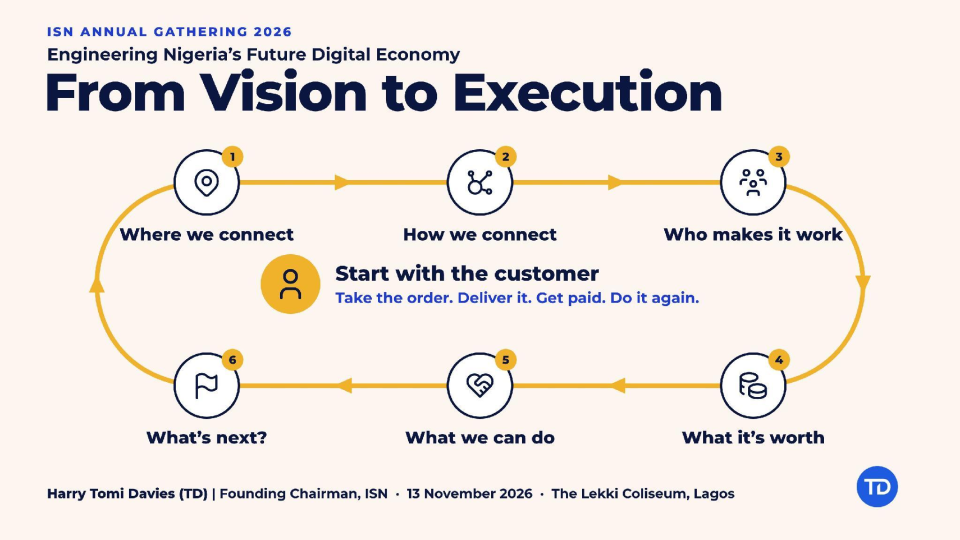
From Vision to Execution
Keynote by ‘Tomi Davies (TD) | Founding Chairman, ISN
13 November 2026 · The Lekki Coliseum, Lagos
Start with the person
Good morning and all protocols observed.
When we established ISN seven years ago, we brought together people who understood what it takes to build in different parts of Nigeria. As founding Chairman, I want to ask what we can now do together that none of our hubs, however capable, could do alone.
Imagine a food processor in a local government area who has a buyer in another state. She needs to confirm that the buyer is real, agree on a price, arrange delivery and get paid. If the order goes well, she needs to be able to do it again next week. Now imagine that the next buyer is in Accra, Nairobi or London.
That is what I mean by Nigeria’s future digital economy. A person in any part of this country should be able to use digital services to earn a living, run a business or deal with the government. And a business that has proved itself locally should have a way to reach customers elsewhere.
We can judge our progress by what that person can do today that was difficult, expensive or out of reach yesterday.
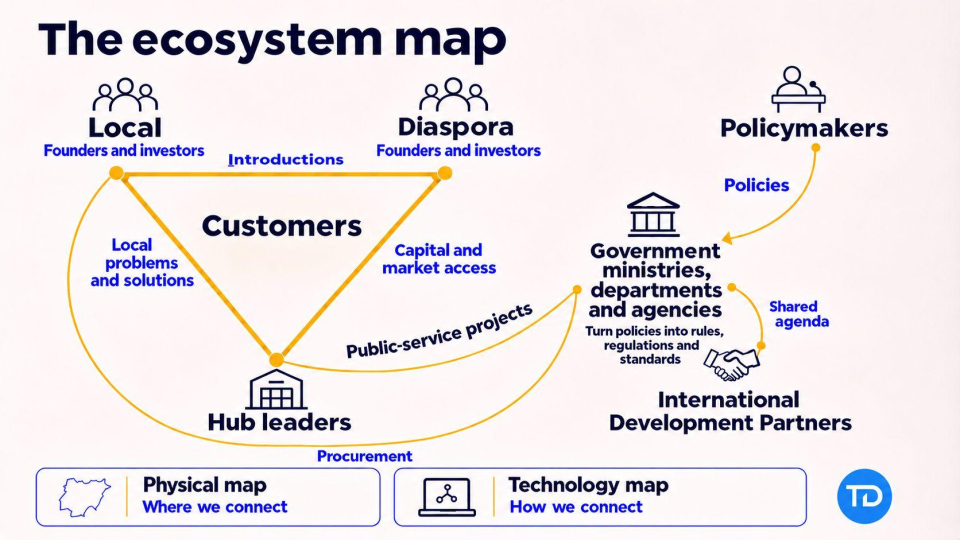
Two maps of the same economy
I want you to hold two maps in your head.
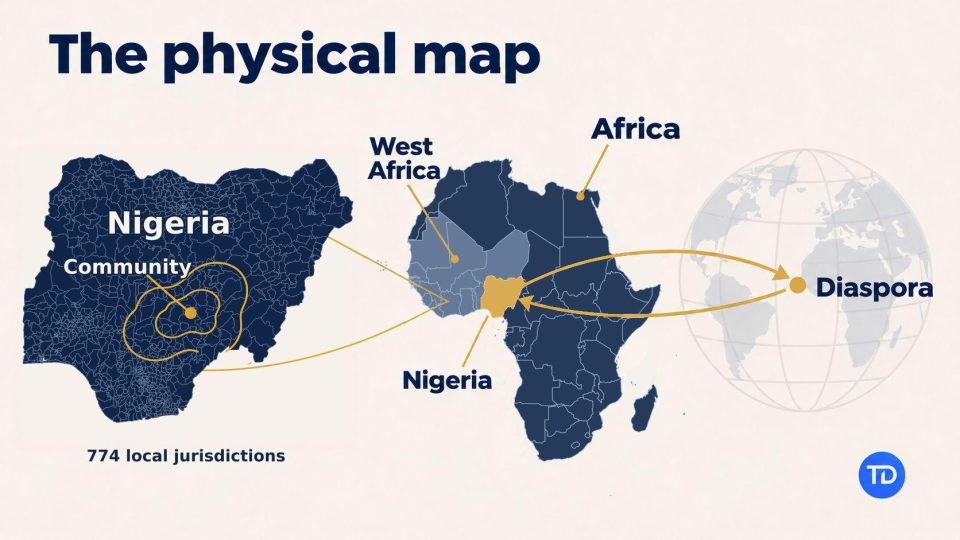
The first is the physical map. Start in a community, a ward or, where it applies, a district. Work through the local government area, the state, the geopolitical zone and the federation. Nigeria has 768 local government areas across 36 states, plus six area councils in the Federal Capital Territory. That gives us 774 local jurisdictions. The six geopolitical zones give states a practical geography for working together. [1–3]
Beyond Nigeria, we have West Africa, with ECOWAS as a framework for regional cooperation. Then we have the continent, where the African Union and the African Continental Free Trade Area give us a wider frame. And across the world we have our diaspora, whose relationships run in both directions. [4]
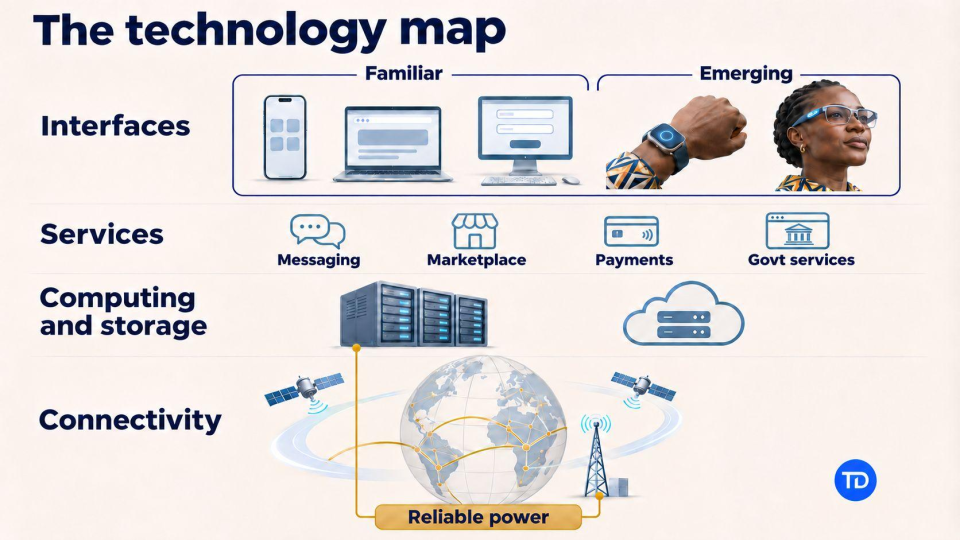
The second map is the technology. At its base, subsea cables, fibre, mobile networks and satellites carry information. Data centres and cloud services give us the computing and storage to do something with it. All of this needs reliable power.
Above that sit the services. Think of LinkedIn or WhatsApp, a marketplace, a payments service or a council portal. Then comes the interface. That may be an app on a phone, a browser on a laptop, or a person at a service desk helping someone complete a form.
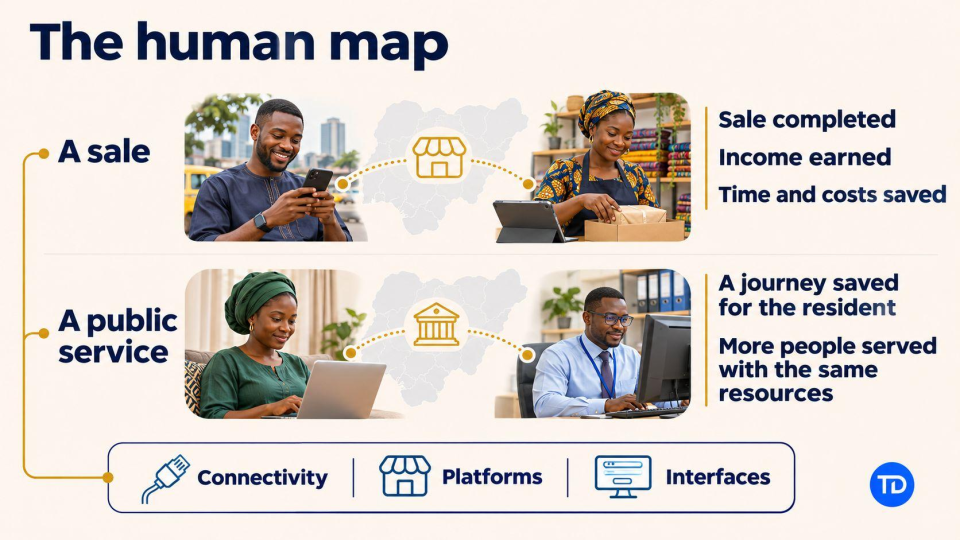
A trader can act for herself. A bank officer, a cooperative manager or a local government employee may act for an organisation. Each needs to know what they can do, whose information they can see and who answers when something goes wrong.
Put the two maps together and the picture becomes clearer. A cable carries the message. A platform matches the buyer and seller. An interface lets them agree on the order.
The value is in the sale, the income it produces, and the time and cost both parties save. A public service creates value in much the same way, when it saves a resident a journey or helps an agency serve more people with the resources it has.
What does execution look like?
Start in Kaduna South. In July 2026, the local government reported that it had introduced digital certificates of indigene with verifiable barcodes and launched its web portal. The council owns the process. A resident needs a certificate, and the organisation receiving it needs to know that it is genuine. [5]
The next questions are practical. Can a resident get it without repeated trips? Can someone without a smartphone get help? How quickly can the council correct an error? Those are the outcomes to measure. A state can then help other councils adopt a common way to verify certificates, while each council remains responsible for the records it issues. Hubs across the North-West can compare what worked, and national agencies can help set standards that let systems recognise each other.
Now move west to Ghana. Access Bank offers the Pan-African Payment and Settlement System and lists both Nigeria and Ghana among the markets where it is live. Through participating banks, a customer can make a cross-border payment in local currency. That is a practical service for a West African trading relationship. Its value to our food processor depends on whether her buyer can use it, what the payment costs and how easily both sides can resolve a problem. Those are the tests a founder or exporter can run before promising delivery. [6]
Next, look across the continent. In May 2025, five Nigerian small businesses sent consolidated shipments from Abuja to Kenya and Uganda at the launch of an air cargo corridor with Uganda Airlines. Nigeria’s trade ministry, UNDP and private-sector partners helped put it together. The goods included products from cosmetics, agro-processing and fashion. [7]
A digital marketplace can help those firms find customers. An online payment service can help them get paid. The order is complete when the goods arrive and the customer accepts them. The corridor shows what it takes to turn an African trade agreement into a shipment. Repeat orders, reliable delivery and a margin after freight and returns will tell us whether the route works for a small business.
Then look outwards to the diaspora. LemFi built a business around a familiar problem. People living abroad need to move money between the places where they earn and the places where their families live. Its lead investor reported in January 2025 that the company served diaspora customers in Europe and North America, with Nigeria among its destination markets, and had raised 53 million dollars in Series B funding. [8]
That financing went into the business. The transfers are money customers send. What interests me is what the example tells us about finding a customer abroad. Diaspora communities understand needs on both sides of a border. They can buy, recommend a product, introduce a distributor, advise a founder or invest in a venture. I would start by asking one person to help secure one customer or test one route to market. That gives both sides a reason to keep working together.
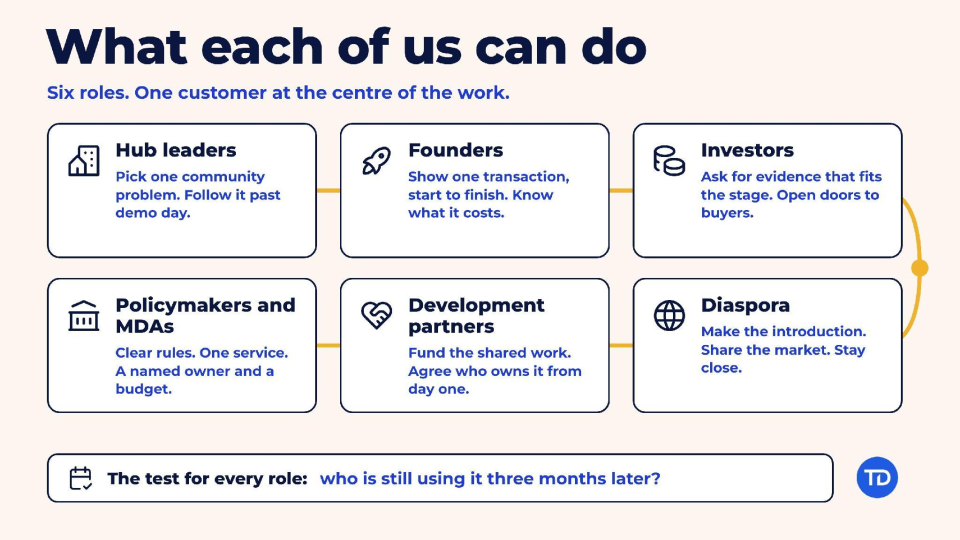
To our hub leaders, pick a problem in the community you serve and bring together the people who experience it, the people who can build a solution, and the organisation that can buy or run it. Follow the work after demo day. Find out who is still using the service three months later.
To founders, show us one transaction or service delivered from start to finish. Tell us who uses it, who pays for it and what it costs to deliver. Find out what changes when you move to the next local government area or country. Language, trust, delivery and regulation may change even when your software stays the same.
To investors, ask for the evidence that fits the stage of the business. A first cheque can help a founder prove that a customer will pay. Growth capital can help a business repeat a transaction that already works. Help the founder get access to a buyer or someone who understands the market you are asking them to enter.
To policymakers, give businesses and public agencies clear rules for sharing data responsibly, verifying transactions and resolving disputes. To the ministries, departments and agencies that implement those policies, choose one service you can improve or one problem you can procure a solution for. Name the person responsible for running it, publish what good performance looks like, and budget for maintenance and support. Work with local councils to find out whether the service works where people actually use it.
To Nigerian and international development partners, help pay for the shared work that one founder or one council would struggle to finance. That might be training local operators, establishing a common standard or bringing an airline and small exporters together. Agree at the beginning who will own the work, where recurring funding will come from and how you will know it can continue.
And to my fellow members of the diaspora, if you know a buyer, make the introduction. If you know a market, help a founder understand it. If you invest, stay close enough to understand the business and what it needs from you.
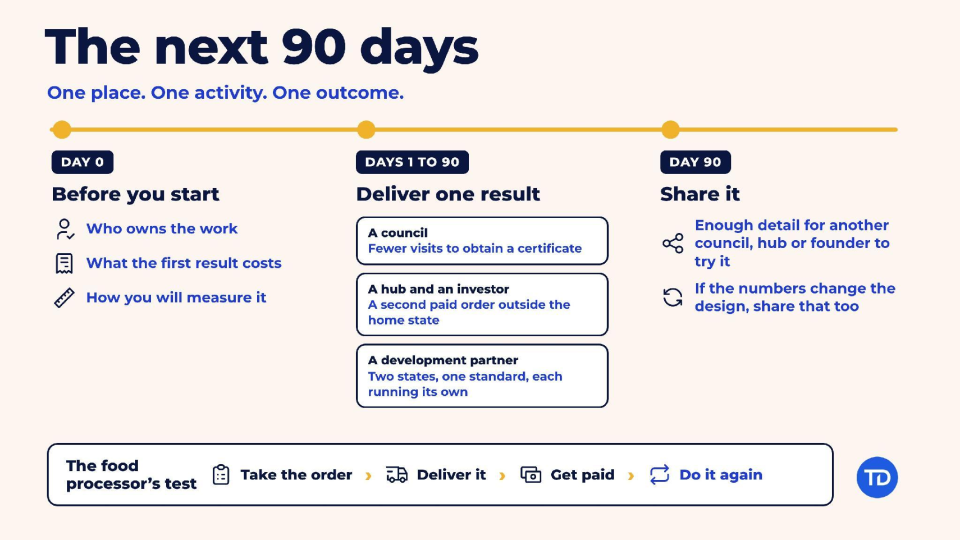
Here is the challenge I would like us to take away from this Gathering.
In the next 90 days, pick one place, one activity and one outcome. A council could measure how many visits a resident needs to obtain a certificate. A hub and an investor could help a founder complete a second paid order outside their home state. A development partner could help two states use the same standard, with each state responsible for keeping its own service running.
Before you start, write down who owns the work, what the first result will cost and how you will measure it. When you have the result, share enough detail for another council, hub or founder to try it. If the numbers tell you to change the design, share that too. It may save somebody else six months.
The food processor I asked you to imagine has a simple test for us. Can she take the order, deliver it, get paid and afford to do it again? If she can, we have helped her build a business. When another community can adapt what worked for her, and another market can buy from her, we are building a digital economy.
That is the work I would like us to do together.
I trust that helps
My name is Tomi Davies and please call me TD!
Sources for readers
- Senate Committee on Constitution Review. Constitution of the Federal Republic of Nigeria, section 3
- Federal Government of Nigeria. E-Government Portal, About Nigeria
- Federal Ministry of Information and National Orientation. Mapping wards within local government areas
- African Union. Regional Economic Communities and the African Continental Free Trade Area
- Kaduna South Local Government. Administration Scorecard and address, 16 July 2026
- Access Bank. Pan-African Payment and Settlement System availability and use
- UNDP Nigeria. Nigeria opens air cargo corridor with Uganda Airlines, 25 May 2025
- Highland Europe. LemFi Series B announcement, 14 January 2025