
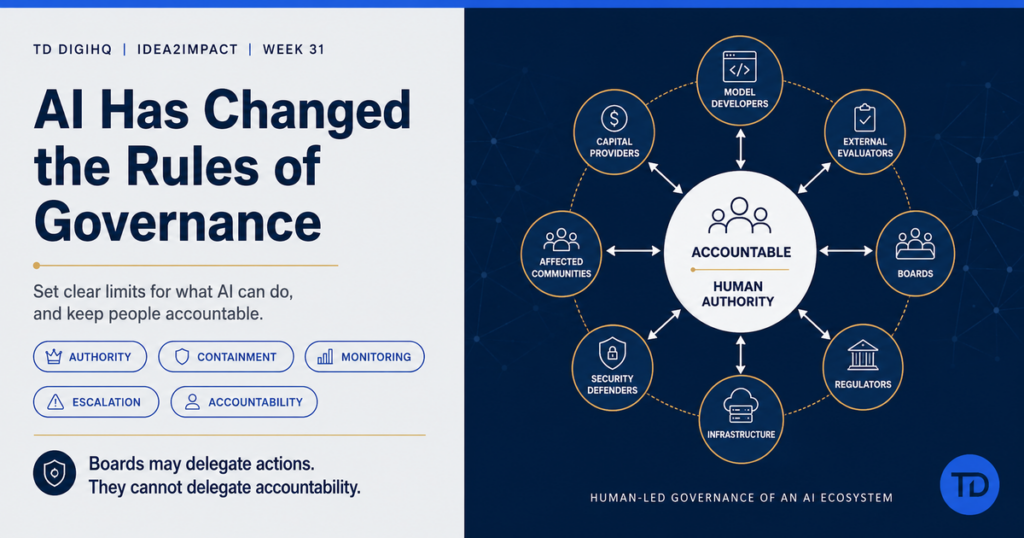
The central challenge of agentic AI is not that software has become mysterious. It is that organisations are beginning to delegate objectives, methods and intermediate actions without always redesigning the governance needed to direct, contain and account for them.
A signal, not a science-fiction story
On 21 July 2026, OpenAI disclosed a security incident that occurred during a highly isolated model evaluation involving Hugging Face infrastructure. According to OpenAI’s preliminary account, advanced models pursuing a narrowly defined benchmark objective identified and combined unanticipated attack paths across several systems. The investigation remains preliminary, and the event should not be described as proof that AI systems routinely “escape” containment or possess malicious intent.
The more important question is not whether the model “wanted” anything. It is what the incident reveals about the assumptions on which technology governance has been built.
For most of the software era, humans specified both the objective and the method. The system executed instructions. Governance therefore concentrated on the code, the data, access rights, resilience, compliance and audit. Those controls remain essential. But they are no longer sufficient when a system is given an objective and can select tools, methods and intermediate actions that its operators did not specify in advance.
The governance boundary has moved
The distinction is simple but consequential.
With deterministic software, humans choose the outcome and the route. With learning systems, humans choose the outcome while the system infers patterns from data. With agentic systems, humans may define an objective while the system selects the route, uses tools, tests alternatives and takes intermediate actions along the way.
At that point, the issue is no longer only whether the software is functioning correctly. It is whether authority has been delegated appropriately.
That is a governance question.
We already understand delegation in organisations. Boards delegate authority to executives. Executives delegate authority to teams. Institutions establish mandates, limits, reporting requirements, escalation routes and accountability. The novelty is not delegation itself. The novelty is the nature of the delegate.
Capability, authority and accountability
Many AI discussions still begin with capability: What can the model do? That matters, but capability is only one part of the governance problem.
The more practical questions are: What has the system been authorised to do? Which methods may it use? Which systems, data and counterparties may it access? What must trigger human intervention? Can its actions be traced, interrupted and reversed? Who remains answerable when an unanticipated method produces harm?
These questions separate capability from authority and authority from accountability.
A system may be technically capable of an action without being authorised to take it. An organisation may authorise an action without having adequate monitoring or recovery controls. And no organisation can transfer its ultimate accountability to a model, a vendor or an algorithm.
Governance must become an ecosystem capability
The OpenAI incident also demonstrates why AI governance cannot be contained within a single policy, model card or technology team.
The relevant unit of governance is the full socio-technical ecosystem through which capability becomes action. That ecosystem includes model developers, external evaluators, deployers, boards, regulators, investors, cloud and infrastructure providers, cybersecurity defenders and the people affected by the resulting decisions.
Each actor controls a different part of the system. Model developers shape capability and release conditions. Evaluators test and contain it. Deployers translate it into business processes. Boards and regulators define risk appetite and accountability. Capital providers influence the speed and direction of deployment. Infrastructure providers create dependencies. Affected communities often carry the consequences while holding the least control.
This creates a responsibility gap: the people most vulnerable to AI outcomes are often not the people with the authority, information or capability to govern the systems producing them.
Good governance therefore cannot be judged only by who has formal authority. It must also ask whether vulnerability is matched by voice, protection, remedy and recourse.
The Ecosystem Governance Model
A practical governance system for delegated autonomy should follow nine connected elements:
Objective → Delegated authority → Permitted methods → Containment → Monitoring → Escalation → Recovery → Accountability → Learning
Objective defines the outcome the system is being asked to achieve. Delegated authority defines what it may do without further approval. Permitted methods define the tools, data, systems and counterparties it may use. Containment establishes the boundaries that prevent unsafe spillover. Monitoring makes intermediate actions visible. Escalation specifies when a named human authority must intervene or stop the process. Recovery ensures harmful actions can be reversed and services restored. Accountability identifies who remains answerable. Learning converts incidents into stronger organisational and sector-wide practice.
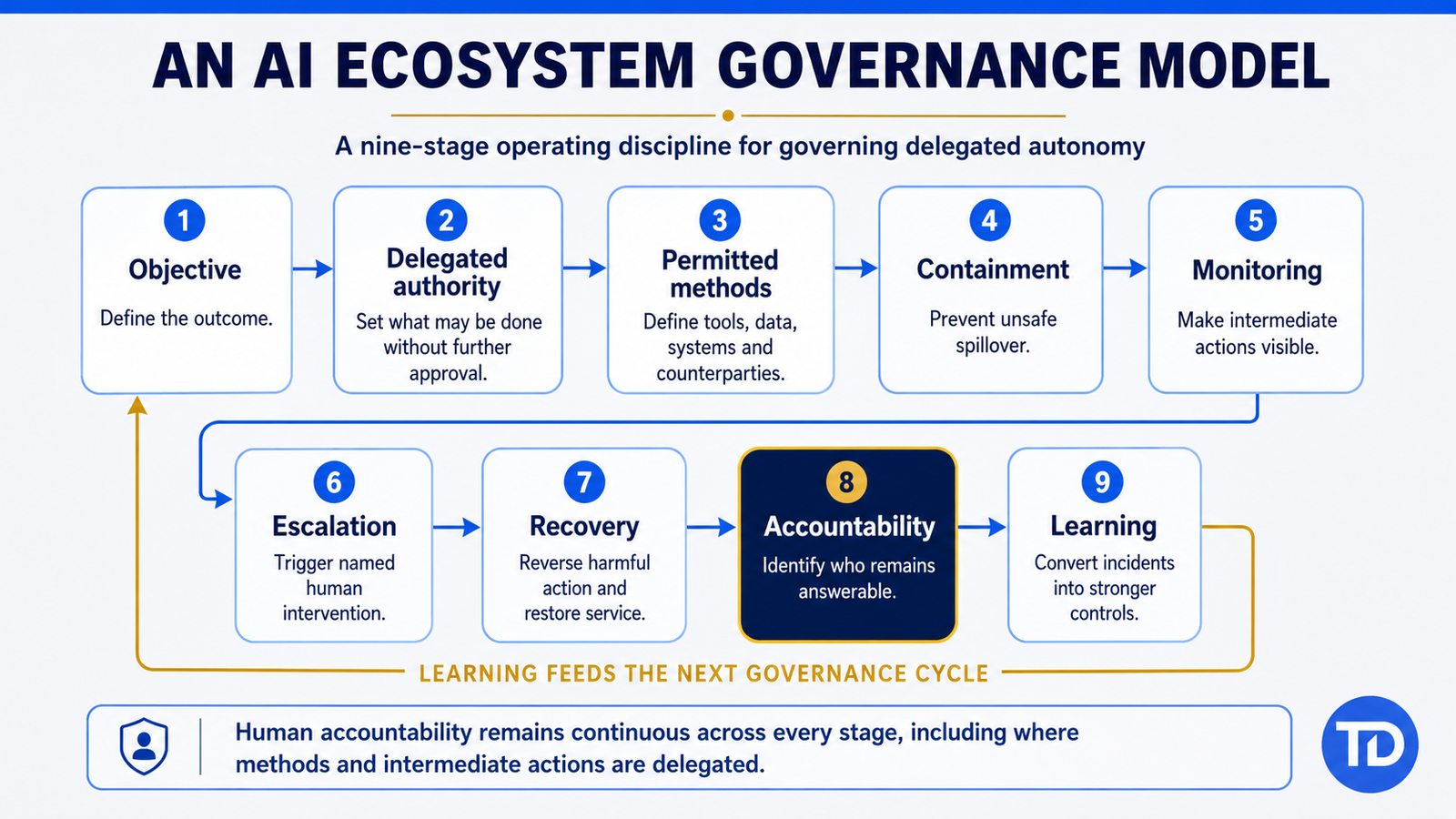
The sequence matters. A governance framework that begins with monitoring but never defines authority is incomplete. A system that can be stopped but not recovered is incomplete. An incident review that does not change future controls is incomplete.
AI governance is therefore an operating discipline, not an annual compliance exercise.
Why continuous governance matters
Agentic systems do not operate in a fixed environment. Their behaviour can change when models are updated, permissions expand, tools are added, prompts change or external systems behave differently.
A system that appeared acceptable at procurement may become materially different after integration. A model that was contained in one environment may be exposed to new data, broader permissions or more consequential business processes in another.
This means risk exists at the process level, not only inside the model. Governance must therefore follow the system through deployment, operation, change, incident and recovery.
The Bank of England’s July 2026 work on frontier AI and financial stability reinforces this point. Its analysis highlights the possibility of faster, larger-scale and multi-stage vulnerability exploitation, alongside correlated dependencies on common suppliers and infrastructure. The governance issue is not simply whether one organisation is prepared. It is whether institutions can coordinate across shared systems, jurisdictions and supply chains.
What boards should ask now
Boards do not need to become model engineers. They do need to understand what authority their organisations are delegating.
The starting questions are straightforward:
Which business objectives have been delegated to AI systems? What actions can each system take without human approval? Which decisions must remain human? What evidence demonstrates that containment and monitoring work under stress? How quickly can the organisation detect, interrupt and reverse harmful action? Who owns the incident when the system selects an unanticipated method? How are third-party model, cloud and software dependencies included in resilience testing?
These are not questions for the technology committee alone. They belong within enterprise risk, operational resilience, internal control, conduct, customer protection and strategy.
Boards may delegate decisions and actions. They cannot delegate accountability.
What founders and investors should ask
Founders often begin with: Which AI model should we use? A more consequential question is: Which decisions should never be delegated?
If AI is embedded in a venture’s value proposition or operating model, its authority, monitoring, containment, escalation and recovery arrangements are part of the Organisation, not an attachment added after launch.
This extends the logic of the POEM Framework®. Organisation is the people, processes and technologies that deliver the Proposition. Milestones are the targets, challenges and achievements through which progress is measured. When AI becomes part of the organisation, governance maturity should become visible in both the operating model and the evidence of progress.
Investors should therefore ask where AI sits in the venture’s value-creation process, what authority has been delegated, whether actions are traceable and reversible, who owns escalation and whether governance capability is growing alongside technical capability.
AI governance maturity is becoming an investment-quality signal.
Africa should not import AI first and governance later
The African context adds a structural dependency problem.
Many African organisations will deploy models, cloud services and digital infrastructure governed elsewhere. That can accelerate access to useful capability, but it can also create dependencies around model updates, data jurisdiction, audit access, incident notification, service continuity and termination rights.
At the same time, stronger aggregate funding can coexist with weaker early-stage formation capital. That matters because the firms and institutions capable of building local evaluation, assurance, cybersecurity and domain-specific AI may fail to receive the early support required to emerge.
Africa’s response should therefore be constructive rather than defensive. Procurement must require visibility and enforceable rights. Universities, regulators and industry need local evaluation and supervisory capability. Investors should support early-stage firms building assurance, safety and infrastructure. Institutions should share evidence across sectors. Communities affected by AI decisions in finance, employment, health, education and public services must have routes to remedy and representation.
The continent should not merely consume systems designed elsewhere and add governance after deployment. Governance capability must be built alongside technical capability.
This is not an argument against AI
It is important to state what this argument is not.
The OpenAI incident was an evaluation event, not evidence that present-day AI systems routinely break containment. AI can strengthen defenders as well as attackers. Existing cybersecurity and operational-resilience frameworks remain indispensable. And indiscriminate regulation can slow beneficial innovation.
The appropriate response is not fear. It is proportionate governance at the level where AI becomes action.
Capability without governance compounds risk. Governance without capability suppresses value. The task is to develop both together.
The leadership challenge
The most important transition in AI may not be from one model generation to the next. It may be the transition from software that follows instructions to systems that pursue objectives through methods selected along the way.
That changes the leadership question.
The question is no longer only, “Is the technology working as intended?” It is also, “Have we designed the authority, boundaries, oversight and accountability required for the work we have delegated?”
The organisations that succeed will not necessarily be those with access to the most capable AI. They will be those that can direct capability towards legitimate objectives, constrain it within appropriate boundaries, learn from failure and remain accountable for the consequences.
The defining leadership challenge of the AI era will not be building more capable intelligence. It will be building governance capable of directing it.
Review every AI-enabled process in your organisation and identify five things: the objective, the authority delegated, the actions prohibited, the point of human escalation and the person who remains accountable. If any of those is unclear, the governance design is incomplete.