

Credible founders rarely first appear in a pitch room. They emerge through customers, colleagues and communities that see them work before capital does. The investor’s advantage lies in recognising those signals and becoming useful before the founder becomes obvious.
At Wimbledon, Linda Nosková won her first Grand Slam title. In the 2026 FIFA World Cup, England’s run ended in the semi-final, where Argentina won 2–1.
Both events placed talent under maximum public scrutiny. Millions could see the athletes who had survived years of selection, coaching and competition before arriving at that moment.
But visibility is not where discovery began.
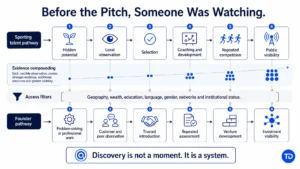
Long before the ranking, national shirt or television audience, somebody closer to the work was paying attention. A teacher noticed discipline. A local coach saw unusual movement or judgement. A junior competition provided comparison. An academy then supplied better coaching, stronger opposition and repeated assessment.
Public recognition was the output of a discovery and development system.
The same principle applies to founders. Credible founders usually appear first to people who can see them working: customers, colleagues, suppliers, lecturers, technical peers, former managers and community leaders.
By the time they reach an accelerator, pitch event or funding announcement, several people may already have supplied encouragement, evidence, references and access.
The founder has not suddenly been discovered. The founder has become visible to capital.
My central proposition is straightforward. Sustainable sourcing advantage does not come merely from meeting a promising founder early. It comes from recognising meaningful early signals, observing them over time and helping the founder convert capability into evidence before the wider market notices.
The first observer is rarely the investor
Investors like to speak about proprietary deal flow. The phrase suggests that attractive opportunities reach us through privileged channels before becoming widely available.
That is sometimes true. It can also give the eventual investor rather too much credit.
The first useful observer may be a customer who keeps using an imperfect product because it solves a real problem. It may be a colleague who watches someone repeatedly accept responsibility beyond a formal role. It may be a lecturer who recognises technical depth, or a supplier who notices commercial discipline.
The person who eventually writes the cheque may be several relationships removed from the person who first saw the capability.
This is why founder sourcing should begin with a different question. Not simply, “Where can we find founders?” but, “Who is already close enough to see them doing difficult work?”
Universities, professional bodies, customer communities, laboratories, diaspora groups, innovation hubs and established companies can all become discovery environments.
They become a discovery system only when credible observations can travel from those close to the work towards people able to provide the next opportunity.
A pitch competition can generate applications. A functioning network carries observation, context and trust.
Early evidence appears in different forms
My own portfolio relationships reinforce that point, although they followed different routes.
Okey Esse’s public account describes encountering me in South Africa while Powerstove was still proving that a stove could burn cleanly and generate electricity. His account emphasises the inventor, the early technical breakthrough and the resources, time and network that followed as the company developed.
Tomiwa Aladekomo describes a different pattern through Big Cabal Media. His account places our relationship across fundraising, pragmatic problem-solving, board service and periods when the going was difficult.
Neither account presents founder judgement as a single moment of selection. Both show evidence accumulating through continued engagement.
Founder capability may first appear through an invention, an earlier venture, a professional role, a customer problem or the way someone responds when the original plan stops working.
The common signal is not uninterrupted success.
It is the capacity to learn, assemble people, interpret evidence and keep moving towards a worthwhile purpose.
A pitch is a highlight reel
A pitch has a legitimate purpose. A founder must explain the problem, customer, proposed solution, route to market and case for investment.
But a pitch is staged performance.
It can reveal clarity, confidence and preparation. It tells us less about how someone responds to missed targets, customer rejection, contrary evidence or an uncomfortable challenge to an assumption.
Persistence becomes visible over time. So do integrity, focus and learning speed.
A founder who accepts every suggestion is not necessarily coachable. They may simply be eager to please. A founder who rejects advice is not necessarily stubborn. The advice may be wrong.
The useful evidence appears in what happens next.
Does the founder investigate the issue? Do they return with better evidence? Can they explain why the direction changed, or why it did not? Do they disclose bad news early? Can they attract people who strengthen the venture rather than simply admire its vision?
Repeated interaction is not merely a longer interview. Done properly, it creates an environment in which the founder and the prospective investor can both test whether the relationship produces better judgement and stronger execution.
Context changes the meaning of performance
Raw performance rarely tells the whole story.
One founder may have family capital, elite education, strong professional networks and early customers willing to take a chance.
Another may be operating in a secondary city, managing unreliable infrastructure, working outside recognised startup circles and serving customers with limited purchasing power.
The first company may show larger numbers. The second founder may have demonstrated greater resourcefulness.
This is not an argument for lowering standards. It is an argument for improving interpretation.
Investors should ask what the founder achieved relative to the resources, access and constraints available. We should also examine whether our referral networks repeatedly reproduce the same cities, schools, professions, languages and social circles.
Warm introductions provide useful context. They are not neutral.
They can turn familiarity into an unexamined proxy for quality.
The answer is not to abandon referrals in favour of anonymous applications. Formal applications can widen access, but they also reward people who understand how institutions expect founders to present themselves.
The better approach is to build bridging relationships with credible observers in places capital does not routinely visit.
Pattern recognition is useful. Pattern exclusion is what happens when it becomes too comfortable with itself.
Finding and following are one system
Recognising potential is only the beginning.
A promising founder may still need stronger customer evidence, pricing discipline, governance, financial controls, technology, people and milestones.
Early discovery creates little enduring advantage unless the investor or support organisation can remain useful through that development.
For me, Find, Fund and Follow form one operating rhythm.
Find creates proximity to the founder and the problem.
Fund provides appropriate capital once investment-worthiness has been demonstrated.
Follow supplies attention, governance, networks and continued judgement as the venture develops.
The POEM Framework® provides structure for that progression.
The founder’s vision must become a credible Proposition. The venture needs an Organisation capable of reliable delivery. Its Economics must show how resources become revenue and impact. Its Milestones must demonstrate disciplined progress.
Finding without the capacity to observe and develop is little more than spotting.
In practice, it may amount to having the privilege of rejecting founders before everybody else does.
Early access is not conviction
There is a strong counterargument.
Early evidence is noisy. Potential can be difficult to distinguish from optimism. Familiarity can make an investor less objective rather than better informed. Waiting for repeat customers, stronger governance, revenue or a functioning team may be entirely rational.
Later investors may accept a higher valuation in exchange for lower uncertainty. Visible traction may also be fairer than a personal judgement about who looks or sounds like a founder.
The purpose of early discovery is therefore not to invest earlier at any cost. It is to begin learning earlier.
Access should not be confused with conviction.
An interesting signal earns further attention, not an automatic cheque.
Five questions before the pitch
- Who has observed this person doing difficult work before fundraising began?
- What has the founder achieved relative to the resources and access available?
- What changes between the first, fifth and tenth interaction?
- Can early capability become evidence across Proposition, Organisation, Economics and Milestones?
- Who will remain useful after the founder has been found?
The best founders are not necessarily hiding. Many are already visible to people around their work.
The real advantage is building a system in which those observations can travel, the signals can be tested and promising people can become stronger before everybody else arrives.
Discovery is not a moment. It is a system.
Use the five questions to audit one existing founder-sourcing channel. Identify who is observing founders before they enter the pipeline, what evidence travels with the introduction and who remains useful afterwards.
I trust that helps.