

A founder-sourcing funnel processes opportunities. A discovery system captures signals, builds evidence, routes founders responsibly and learns from its decisions. The distinction determines whether founder discovery remains personal intuition or becomes institutional capability.*
In 2025, 1,117 startups applied to UNDP’s timbuktoo ManuTech programme. The process selected 121 for bootcamp and incubation, after which 67 completed the requirements to become eligible for the acceleration phase. Twenty eventually advanced. The final selection used submitted work, a ten-minute pitch and a standard 100-point scoring system. The assessment considered the problem and solution, market understanding, business model, financial viability, team capacity, execution and growth potential. This is more structured than moving directly from an application to a funding decision. It creates stages, evidence requirements and decision gates. It also reveals the limits of the conventional founder funnel.
The published process explains how eligible ventures were assessed at the final stage. It says less about how the original founders became visible, which observations accumulated during the programme, how those observations influenced the decision or what route was available to founders who were not selected. That distinction matters. A funnel processes opportunities already inside the institution. A discovery system determines how signals enter, what they mean, what evidence should follow and where each founder should go next. The purpose of early discovery is not to prove investment-worthiness. It is to decide the next responsible use of attention.
A signal is not a finding
In “Founder sourcing before the pitch” I established the fact that credible founders often become visible first to customers, colleagues, suppliers, lecturers, professional peers and communities. The investor usually arrives later, after someone closer to the work has already observed something meaningful. This article asks what an institution should do with that observation. A customer may report that a founder consistently solves an important operational problem. A technical peer may recognise unusual depth. A supplier may observe planning and payment discipline. A mentor may see how a founder responds to challenge. Each observation may deserve attention. None should be treated as a complete judgement about the founder or venture. A useful signal identifies something specific, relevant and capable of being tested. “Strong founder” is an endorsement. “I saw her retain three demanding customers through repeated product failures and communicate each delay before being asked” is evidence-bearing observation. The first task of a discovery system is therefore not ranking. It’s qualification. Who made the observation? What did they directly see? Over what period? How is it relevant to the next decision? Can it be corroborated?
A signal earns a question. It doesn’t earn a cheque.
Ask only for the evidence the next decision requires
Institutions often ask for too much too early. A founder introduced for an exploratory conversation may immediately receive a long application form, financial-model request and data-room checklist. The organisation behaves as though every new contact is already approaching an investment committee. That creates cost without necessarily improving judgement. Early discovery, screening, structured engagement, assessment and due diligence are different activities. An initial signal may require only basic information about the founder, problem and stage. An introductory conversation may test whether the opportunity fits the institution’s remit and whether further attention could produce useful evidence. A programme place may require proof of commitment and sufficient readiness to benefit. Formal diligence should begin only when a serious commitment involving capital, reputation or institutional authority is under consideration.
The governing rule is simple: At every stage, request only enough evidence to decide the next responsible use of attention.
This is not a softer standard. It is better sequencing. Evidence should become more demanding as institutional commitment increases. The distinction matters because early-stage judgement remains uncertain. An NBER study examined more than 8,000 opportunities sourced by one early-stage venture-capital firm. The investor displayed meaningful selection ability, but the results were still noisy. Only 32 per cent of invested companies later raised more than US$10 million, while 13 per cent raised more than US$25 million. Team assessments helped explain initial funding, but market and product evidence carried more explanatory value for larger financings and longer-term outcomes.
Early impressions can be useful. They’re not final.
The system should route, not merely accept or reject
Most funnels narrow towards one desired outcome. The founder advances or stops. The programme admits or declines. The investor proceeds or passes. A strong discovery system has more than one responsible destination. A founder with an interesting signal but limited evidence may need an introductory screen. Another may need mentoring, customer validation or a defined observation period. A venture with a clear readiness gap may benefit from advisory support. A credible founder outside the institution’s mandate may deserve a contextual referral elsewhere.
Some opportunities should proceed to structured assessment. A smaller number should enter diligence. Others should be monitored against a clear milestone or declined with an intelligible reason. Routing protects institutional time without turning every non-advance into a verdict on founder quality. This is particularly important because programme readiness, investment readiness and founder capability are not identical. A founder may be too early for one programme and exactly right for another. A venture may be unsuitable for equity investment but appropriate for customer introductions or technical support. Timing may change. Evidence may develop.
A closed funnel forgets these distinctions. A discovery system preserves them.
Use repeated interaction to test, not merely to watch
Repeated observation can reveal what a pitch cannot. Follow-through, evidence discipline, customer orientation, response to setbacks and use of feedback become more visible over time. Yet repeated interaction does not automatically create better evidence. Ten conversations may produce familiarity and affection without testing anything that matters. Each engagement should therefore address an unresolved proposition.
Does the founder understand the problem beyond the original story? Can a customer confirm the claimed value? Does the founder return with evidence after an assumption is challenged? Does the team deliver an agreed milestone? Do later claims remain consistent with earlier ones?
Evidence becomes stronger when it moves from unsupported assertion to specific observation, independent corroboration, documented performance and repeated performance across time. It may also become weaker. A responsible system must preserve contradictions as carefully as confirmations. This is where the POEM Framework® becomes relevant but shouldn’t replace discovery or dominate the first interaction. It provides a structured assessment once sufficient evidence exists to examine the Proposition, Organisation, Economics and Milestones of the venture. Find should produce qualified attention and progressively stronger evidence. Fund should begin only after investment-worthiness has been demonstrated.
Institutional memory is the overlooked advantage
A founder pipeline that depends on one investor’s memory or one programme manager’s relationships is not an institutional capability. It’s personal capacity wearing an organisational badge. The system should record the source of the signal, what was observed, why the opportunity advanced, what evidence was requested, where the founder was routed and why the case paused or stopped. It should also revisit outcomes. Which referral channels repeatedly produced relevant founders? Which early signals proved useful? Where did assessors disagree? Which founders advanced later after an initial decline? Which locations, sectors and founder profiles remain persistently absent?
This matters in Africa, where capital remains geographically concentrated. Egypt, Kenya, Nigeria and South Africa received 82 per cent of reported African startup funding in 2025. That describes where capital went. It does not establish that founder capability exists in the same proportions. A discovery system should therefore examine not only whom it selected, but whom its channels never allowed it to see. The purpose is not to force equal outcomes or pretend all opportunities are equivalent. It’s to identify whether the institution keeps drawing conclusions from a narrow field of visibility. Without outcome review, the organisation cannot distinguish a productive sourcing channel from a familiar one.
A pipeline that never learns which signals were reliable is merely an organised inbox.
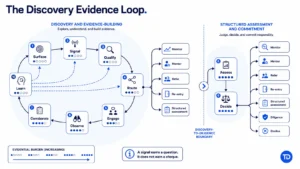
The Discovery Evidence Loop
Surface → Signal → Qualify → Route → Engage → Observe → Corroborate → Assess → Decide → Learn
- Surface: Identify the places and relationships where credible founders may become visible.
- Signal: Capture a specific observation that may justify attention.
- Qualify: Test whether the observation is relevant, first-hand, specific and capable of further examination.
- Route: Select the next responsible pathway.
- Engage: Use a proportionate interaction to generate new evidence.
- Observe: Record behaviour, progress and contradiction over time.
- Corroborate: Test claims through customers, records, references or operating evidence.
- Assess: Apply structured judgement once the evidential burden is justified.
- Decide: Advance, monitor, redirect, refer or decline.
- Learn: Compare the original signal and institutional decision with what happened later.
The loop should not become a rigid scorecard. Founders differ, contexts differ and not every form of evidence can be reduced to a number. Its purpose is to preserve judgement while making the process explainable, proportionate and capable of improvement. Last week was about finding the signal. This Week is about ensuring that signal doesn’t disappear into someone’s inbox, become inflated into premature conviction or end in an avoidable rejection. The discovery advantage belongs to the institution that can convert scattered observations into responsible attention, stronger evidence and the right next pathway.
Build the discovery system. The funnel will then know what its for.
Audit one current sourcing process against the Discovery Evidence Loop. Identify where signals enter, what evidence is requested, which alternative routes exist and whether the organisation ever reviews what happened after its decision.